|
|
 |
|
| Posted By |
Message |
babywanted
LIF Zygote
Member since 1/07 16 total posts
Name:
|
another o question
 ok i know this is silly but i have heard that u can try to concieve (well start) a day after AF has finished is this true,also can anyone tell me if i have made an error reguarding fertile days being 14 days after AF has been ok i know this is silly but i have heard that u can try to concieve (well start) a day after AF has finished is this true,also can anyone tell me if i have made an error reguarding fertile days being 14 days after AF has been
TIA
|
Posted 1/11/07 8:19 AM  |
| |
|
Long Island Weddings
Long Island's Largest Bridal Resource |
MrsPornStar
Partners in crime

Member since 10/05 14656 total posts
Name:
Mama
|
Re: another o question
This is from the American Pregnancy Association . HTH!
From the Menstrual Period to Ovulation (the details you may not know!)
When your menstrual cycle begins, your estrogen levels are low. Your hypothalamus (which is in charge of maintaining your hormone levels) sends out a message to your pituitary gland which then sends out the follicle stimulating hormone (FSH). This FSH triggers a few of your follicles to develop into mature eggs. One of these will develop into the dominant follicle, which will release a mature egg and the others will disintegrate. As the follicles mature they send out another hormone, estrogen. The high levels of estrogen will tell the hypothalamus and pituitary gland that there is a mature egg.
A luteinizing hormone (LH) is then released, referred to as your LH surge. The LH surge causes the egg to burst through the ovary wall within 24-36 hours and begin its journey down the fallopian tube for fertilization. The follicle from which the egg was released is called the corpus luteum, and it will release progesterone that helps thicken and prepare the uterine lining for implantation. The corpus luteum will produce progesterone for about 12-16 days (the luteal phase of your cycle.) If an egg is fertilized, the corpus luteum will continue to produce progesterone for a developing pregnancy until the placenta takes over. If fertilization does not occur the egg dissolves after 24 hours.
At this time your hormone levels will decrease and your uterine lining will begin to shed about 12-16 days from ovulation. This is menstruation (menstrual period) and brings us back to day 1 of your cycle. The journey then begins all over again.
The time of ovulation is one of the most important things a woman should understand about her body, since it is the determining factor in getting pregnant and preventing pregnancy. The process can be confusing and somewhat overwhelming when trying to understand. The Association recommends using an ovulation kit or fertility monitor to maximize your chances and to confirm when your ovulation is occuring. There are many frequently asked questions about the ovulation process, and the Association has attempted to address those for you. If you still have further questions regarding ovulation, we encourage you to either talk with your healthcare provider or contact the American Pregnancy Association for more information. Being informed on what your body does can help you feel more in charge of your health.
|
| Posted 1/11/07 8:33 AM |
| |
|
MrsPornStar
Partners in crime
Member since 10/05 14656 total posts
Name:
Mama
|
Re: another o question
This is from Fertility Friend
Lesson Objectives:
Understand the concept of “the fertile window”.
Know which days are the most fertile days.
See how fertility charting can help you find your fertile days and increase your conception chances.
Major Points in this Lesson:
There are just a few days each cycle that you can get pregnant.
The time during your cycle when intercourse may result in conception is called “the fertile window”.
The maximum length of the fertile window is six days.
The most likely days that intercourse will result in conception are the two days before ovulation and the day of ovulation.
Your fertility pattern is unique to you. You may not have a “text-book” fertility pattern.
Charting your fertility signs will help you find your most fertile days and pinpoint your ovulation date.
A significant factor for a large portion of couples who are experiencing conception difficulties is poor intercourse timing relative to ovulation.
Couples who “focus” intercourse in their fertile window have significantly higher conception rates.
More…
Sometimes referred to as “Fertility Awareness” or “Natural Family Planning”, fertility charting is based on the understanding that we can identify the fertile window- the days where conception is possible- by observing our natural fertility signals. In each cycle there are just a few days when conception is possible.
Fertility charting thus involves observing and recording your fertility signs so that you can easily see your daily fertility status and identify your most fertile time. It is highly effective because your body provides clues that tell you about your fertility status throughout your cycle.
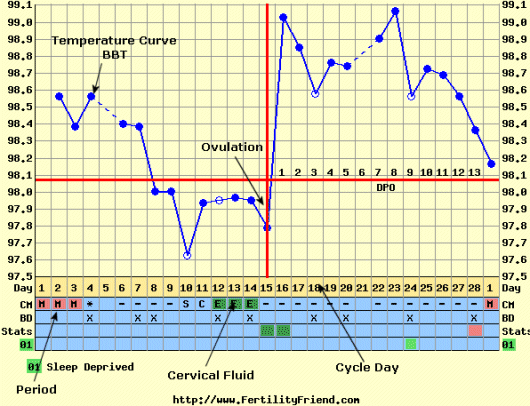
The primary fertility signs are your basal body temperature which rises after ovulation, and your cervical fluid which gets increasingly wet, clear and stretchy as ovulation approaches. (How to observe and chart these signs will be discussed in greater detail in your next lessons).
The days when conception is possible are the days just before and including the day of ovulation. Based on the MAXIMUM lifespan of human sperm and ova, (five days for sperm and one day for the ovum) this fertile window is at MOST six days. This MAXIMUM window is thus made up of the five days before ovulation and the day of ovulation.
Though pregnancy is technically possible during this six day window, most pregnancies actually can be attributed to intercourse from within TWO DAYS before ovulation up to the day of ovulation.
This makes for a practical fertile window of just THREE DAYS each cycle: the TWO DAYS before ovulation and the DAY OF OVULATION itself.
Charting your fertility signs helps you to find those days so that you can best time intercourse to get pregnant. Couples who are aware of their fertile time and focus intercourse during this time have been found to have MUCH HIGHER CONCEPTION RATES than couples who are unaware of their most fertile time.
You may have been told that you ovulate or are most fertile on day 14 of your menstrual cycle, mid-cycle, or even 14 days before your period is expected. These assumptions are based on broad averages and they may not be true for you, even if your cycles are regular.
Your own fertility pattern is unique to you and charting your fertility will help you to see it and find the days that you are most likely to conceive.
To maximize your conception chances, it is recommended to have intercourse every day or AT LEAST every other day during your fertile time until a clear and sustained thermal shift can be detected on your chart.
The chart below shows how fertility charting can show you how to identify your fertile days and your ovulation date.
Image Attachment(s):
Message edited 1/11/2007 8:38:32 AM.
|
| Posted 1/11/07 8:37 AM |
| |
|
Potentially Related Topics:
Currently 415793 users on the LIFamilies.com Chat
|


Long Island Bridal Shows
|
|